
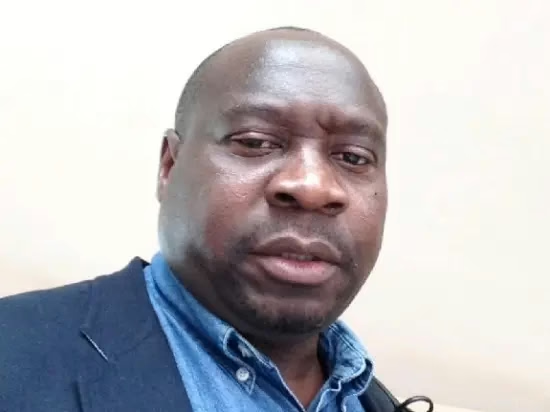
A Zimbabwean-born priest who spent more than two decades ministering in the United Kingdom has been expelled from the United Reformed Church (URC) after admitting to defrauding the institution of over £23,000. The case, which unfolded at Wood Green Crown Court, has not only ended his career in the pulpit but also cast a spotlight on integrity and accountability within faith communities.
Reverend Naison Hove, aged 59, stood before the court where he confessed to making fraudulent claims stretching back over a 12-year period. The court heard that Hove had submitted a total of 13 false applications for allowances that he was not entitled to receive. Among the claims were requests for financial support towards his children’s school uniforms. Prosecutors revealed that despite already enjoying a household income well above the eligibility threshold for such support, Hove continued to pursue the fraudulent claims, diverting church-related funds to his personal use.
For his offences, Hove was handed a two-year suspended prison sentence. While this meant he would not immediately serve time behind bars, the sentence stands as a stern warning. Any further offence during the suspension period could see him jailed.
The scandal marks a dramatic fall from grace for Hove, who was ordained in 2001 and went on to serve congregations across London and Sussex. Throughout his years of ministry, he was seen by many as a respected figure in the church, offering spiritual guidance and pastoral care. However, his career began to unravel in 2022 when the URC launched an internal probe after irregularities were flagged in his financial records.
That investigation uncovered that over a span of more than a decade, Hove had misrepresented his circumstances in order to secure allowances meant to support clergy facing genuine financial hardship. The total misappropriated was calculated at more than £23,000. Armed with the findings, church authorities suspended him from his pastoral duties in 2022. In January this year, following the conclusion of their disciplinary process, the URC made the decision to formally expel him from ministry.


Zimbabwean-Born Priest Dismissed from UK Church Over £23,000 Fraud Scandal
The URC, one of Britain’s long-established Protestant denominations, described the conduct as a betrayal of trust. In a statement carried by Christian news outlets, officials stressed that safeguarding the church’s resources was paramount and that clergy were expected to embody the highest standards of honesty. “Our responsibility is not only to God but also to the congregations and communities we serve. Where breaches of integrity occur, we are compelled to act,” the statement read.
In his defence, Hove’s legal representatives sought to paint a more complex picture of the man behind the fraud. They told the court that he was motivated not by greed but by deep-seated feelings of shame and societal pressure. According to his lawyer, Hove struggled with the traditional expectations placed upon men, particularly in African culture, to be the unwavering providers for their families. Believing he was failing to adequately support his wife and children, he turned to falsifying claims as a way to bridge that perceived gap.
The court, while acknowledging the mitigating circumstances, nonetheless held that the offences spanned too long a period and involved too much deliberate deception to be taken lightly. Judge and jury alike agreed that the suspended sentence struck a balance between punishment and recognition of the defendant’s personal struggles.
For members of his former congregations, the revelations have been both shocking and painful. Parishioners who once looked to him for spiritual leadership now grapple with feelings of betrayal. Some expressed sympathy, citing the immense pressures clergy often face in balancing spiritual responsibilities with personal and family life. Others, however, condemned the actions outright, noting that the misuse of funds undermined the credibility of the church as an institution.
The case also raises broader questions about oversight and transparency in religious organisations. While the URC has pledged to tighten its internal monitoring systems, critics argue that more robust checks should have been in place to prevent such misconduct from continuing unchecked for over a decade. Faith leaders across denominations have since called for renewed emphasis on ethical leadership and the importance of accountability in religious service.
As for Hove, the dismissal has left his future uncertain. No longer permitted to serve within the URC, he faces the task of rebuilding his life away from the pulpit. The stigma of fraud and the loss of his pastoral role will likely follow him for years to come. For a man once entrusted with guiding others in faith, the fall serves as a sobering reminder of the consequences of moral failure.
In the end, the story of Reverend Naison Hove is a cautionary tale—one that highlights how the pressures of societal expectations, if left unchecked, can lead even spiritual leaders down paths of dishonesty. It is also a story that challenges the church to reinforce vigilance in the stewardship of its resources while offering grace and restoration to those who stumble.
Source- Zimetro


